Matplotlib version 1.1 added some tools for creating animations which are really slick. You can find some good example animations on the matplotlib examples page. I thought I'd share here some of the things I've learned when playing around with these tools.
Here we create a figure window, create a single axis in the figure, and then create our line object which will be modified in the animation. Note that here we simply plot an empty line: we'll add data to the line later.

Is the function which will be called to create the base frame upon which the animation takes place. Here we use just a simple function which sets the line data to nothing. It is important that this function return the line object, because this tells the animator which objects on the plot to update after each frame:
Slider Demo — Matplotlib 3.1.2 Documentation
Note that again here we return a tuple of the plot objects which have been modified. This tells the animation framework what parts of the plot should be animated.
This object needs to persist, so it must be assigned to a variable. We've chosen a 100 frame animation with a 20ms delay between frames. The
Keyword is an important one: this tells the animation to only re-draw the pieces of the plot which have changed. The time saved with
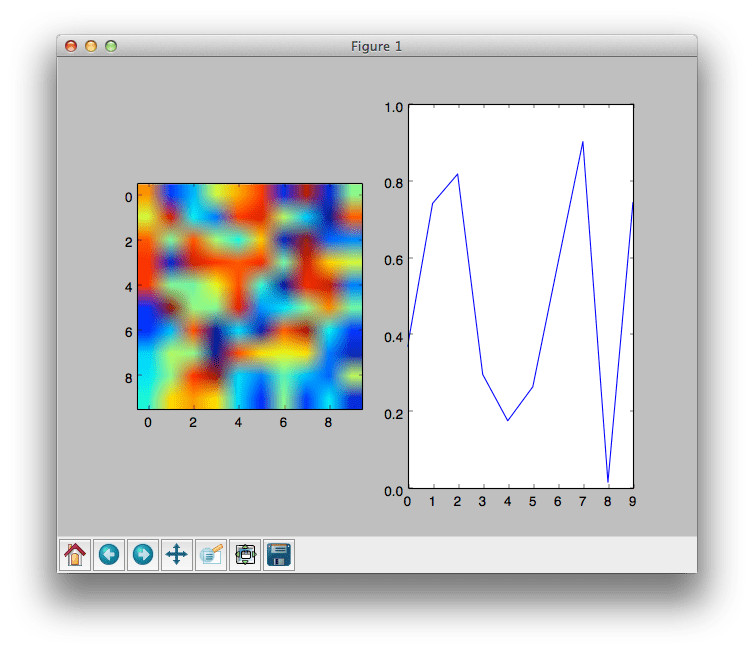
Matplotlib Slider Widget — Mth 337
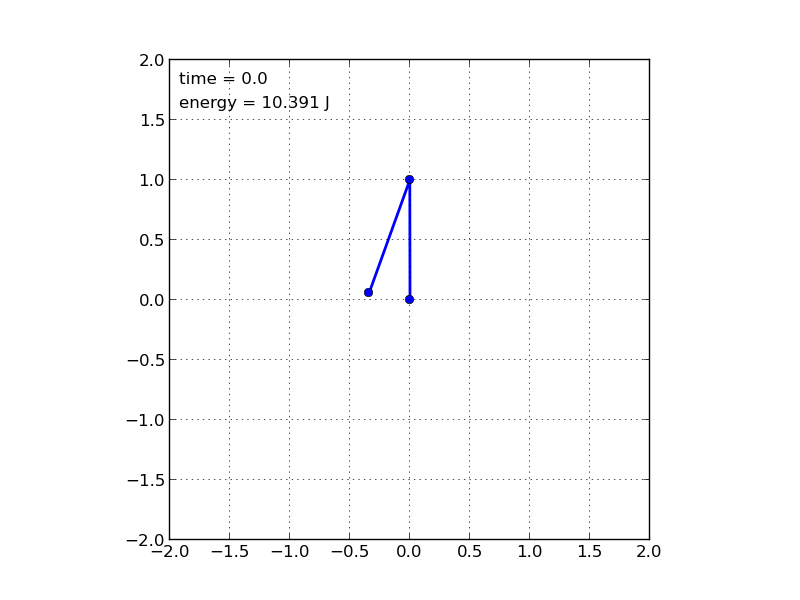
One of the examples provided on the matplotlib example page is an animation of a double pendulum. This example operates by precomputing the pendulum position over 10 seconds, and then animating the results. I saw this and wondered if python would be fast enough to compute the dynamics on the fly. It turns out it is:
Here we've created a class which stores the state of the double pendulum (encoded in the angle of each arm plus the angular velocity of each arm) and also provides some functions for computing the dynamics. The animation functions are the same as above, but we just have a bit more complicated update function: it not only changes the position of the points, but also changes the text to keep track of time and energy (energy should be constant if our math is correct: it's comforting that it is). The video below lasts only ten seconds, but by running the script you can watch the pendulum chaotically oscillate until your laptop runs out of power:
Another animation I created is the elastic collisions of a group of particles in a box under the force of gravity. The collisions are elastic: they conserve energy and 2D momentum, and the particles bounce realistically off the walls of the box and fall under the influence of a constant gravitational force:
Graph Sensor Data With Python And Matplotlib
The math should be familiar to anyone with a physics background, and the result is pretty mesmerizing. I coded this up during a flight, and ended up just sitting and watching it for about ten minutes.
This is just the beginning: it might be an interesting exercise to add other elements, like computation of the temperature and pressure to demonstrate the ideal gas law, or real-time plotting of the velocity distribution to watch it approach the expected Maxwellian distribution. It opens up many possibilities for virtual physics demos...
The matplotlib animation module is an excellent addition to what was already an excellent package. I think I've just scratched the surface of what's possible with these tools... what cool animation ideas can you come up with?

Python Plotting With Matplotlib (guide)
Edit: in a followup post, I show how these tools can be used to generate an animation of a simple Quantum Mechanical system.
The math should be familiar to anyone with a physics background, and the result is pretty mesmerizing. I coded this up during a flight, and ended up just sitting and watching it for about ten minutes.
This is just the beginning: it might be an interesting exercise to add other elements, like computation of the temperature and pressure to demonstrate the ideal gas law, or real-time plotting of the velocity distribution to watch it approach the expected Maxwellian distribution. It opens up many possibilities for virtual physics demos...
The matplotlib animation module is an excellent addition to what was already an excellent package. I think I've just scratched the surface of what's possible with these tools... what cool animation ideas can you come up with?
Python Plotting With Matplotlib (guide)
Edit: in a followup post, I show how these tools can be used to generate an animation of a simple Quantum Mechanical system.

0 Comments
Posting Komentar