In the days before Blender Conference 2022, the Animation & Rigging module organised a workshop: The Future of Character Animation & Rigging. The main participants were Brad Clark, Christoph Lendenfeld, Daniel Salazar, Jason Schleifer, Jeremy Bot, Nate Rupsis, Nathan Vegdahl, Sarah Laufer, and Sybren Stüvel. The main goal of the workshop was to produce design principles for a new animation system, and to design a set of features to make Blender an attractive animation tool for the next decade.
Blender’s animation system is showing its age. The last major update was for Blender 2.50, back in 2009. Since then a lot has been tacked on, improved, and adjusted, but the limitations of how far we can stretch it are showing. These limitations are not just technical, but also in usability, showing themselves in the complicated workflows required to even get started rigging and animating.

The Animation & Rigging module organised a workshop to create a vision for a new animation system. The main goal: to empower Animators to Keep Animating, for the next decade. It also serves to kick off a new project: Animation 2025, which will run from the start of 2023 to the end of 2025. More concrete planning for the project will happen in the coming month.
Create A Perfect Blender 3d Models Animations And Realistic Rendering
In the weeks preceding the workshop there were various meetings to thoroughly prepare for what was sure to become a hectic three days. You can find what was discussed in the meeting notes (2022-09-15, 2022-09-29, 2022-10-03, 2022-10-12, 2022-10-13, 2022-10-17).
These are the design principles for a new animation system. In this section, each principle is explained, and examples are given of how we envision these principles to result in concrete animation & rigging features. In short, they are FIFIDS:
Fast is all about the speed of Blender itself. The faster it is, the more different acting beats you can try out before a shot needs to be delivered. This speed can be categorised as interaction and playback speeds.
Rendering And Animating Cad Models
Fast interaction means that manipulating a rig should feel real-time. This should be achieved with the final deforming mesh, and not some simplified, boxy stand-in. Playback speed concerns replaying animation: doing playblasts and frame jumps. These should be real-time, at the project’s frame rate.
Of course these goals are not just the responsibility of the Blender development team. Regardless of how optimised Blender is, it will always be possible to create complex, slow rigs. During the workshop we thought up tools to help riggers find out how a rig works, and what makes it slow: Rig Explainer and Rig Profiler.
A schematic view of the rig can also be used to show profiling information, giving insight into how much time is spent on each node. For some of these metrics a heat map on the mesh itself could be possible as well:
How To Animate Realistic Looking Guts In The Blender 3d Software « Software Tips :: Wonderhowto
Disclaimer: unfortunately there are limits to how much performance can be squeezed out of real-life computers. The above is thus a guideline, something to work towards, rather than a promise of specific performance numbers on specific hardware.
Understandable, predictable tools allow you to work faster. Working quickly means seeing results faster & having time to explore different things. This can be achieved with tools that are familiar from other software, but more importantly Blender should be highly self-consistent and explorable.
As a counter-example, to start rigging with Blender you need to know about objects, armatures, bones, and potentially also which add-ons to use, like Rigify. After that, you need to know that bone constraints are found in a different place than object constraints. Such issues could be addressed by more intuitive rigging nodes that can be applied to objects and bones alike. Rigs (or even partial rigs) could be contained in component libraries and be slapped onto a mesh or an existing rig. Fuzzy search can help finding the right components, even when you don’t know the exact wording used in Blender.
Any Tips For Creating A Realistic Character Model?
The Rig Explainer, mentioned above as a performance analysis tool, could also be used by the rigger to add notes to the rig, as documentation for other riggers and/or animators. We also want to move away from the old numerical bone layers and have named bone collections instead. This should also give rise to richer selection sets.
Temporary posing tools can make animating easier. For example, a pinning tool can be used to pin a bone in place, automatically making it an IK target, allowing for easy on-the-spot manipulation of an FK chain.

Finally there is the concept of design separation: deformation rigs, animator control rigs, mocap data, and automatic systems (muscles, wrinkles, physics simulations) should interact well together, without getting in each other’s way.
Free Blender Tutorials On Animation, Modeling, Texturing And More
Focused is all about activating flow state. Having atomic, simple tools that can be combined for greater power. The concept of orthogonal tools also plays a role here: tools should not get in each other’s way.
Greater customizability of Blender’s interface will also help to keep animators focused, so that tools are available where they need them, in their personal workflows.
We’ve discussed visualising constraints directly in the 3D Viewport, close to the related 3D items, to avoid having to search for them in a property panel.
Blender Studio — Blender.org
Another improvement would be example-based drivers, where you can just bend a joint and adjust the strength of a shape key, and Blender will understand how they relate and create the driver for you.
A final example would be to separate the viewport frame rate of foreground and background characters. Blender could then prioritise the foreground character when playing back animation. Background characters could update at a lower frame rate, to ensure the main focus of your work plays at real-time rates. Of course this feature would be configurable to suit your needs, and Blender would have to be told which characters it should consider “foreground” and “background”.
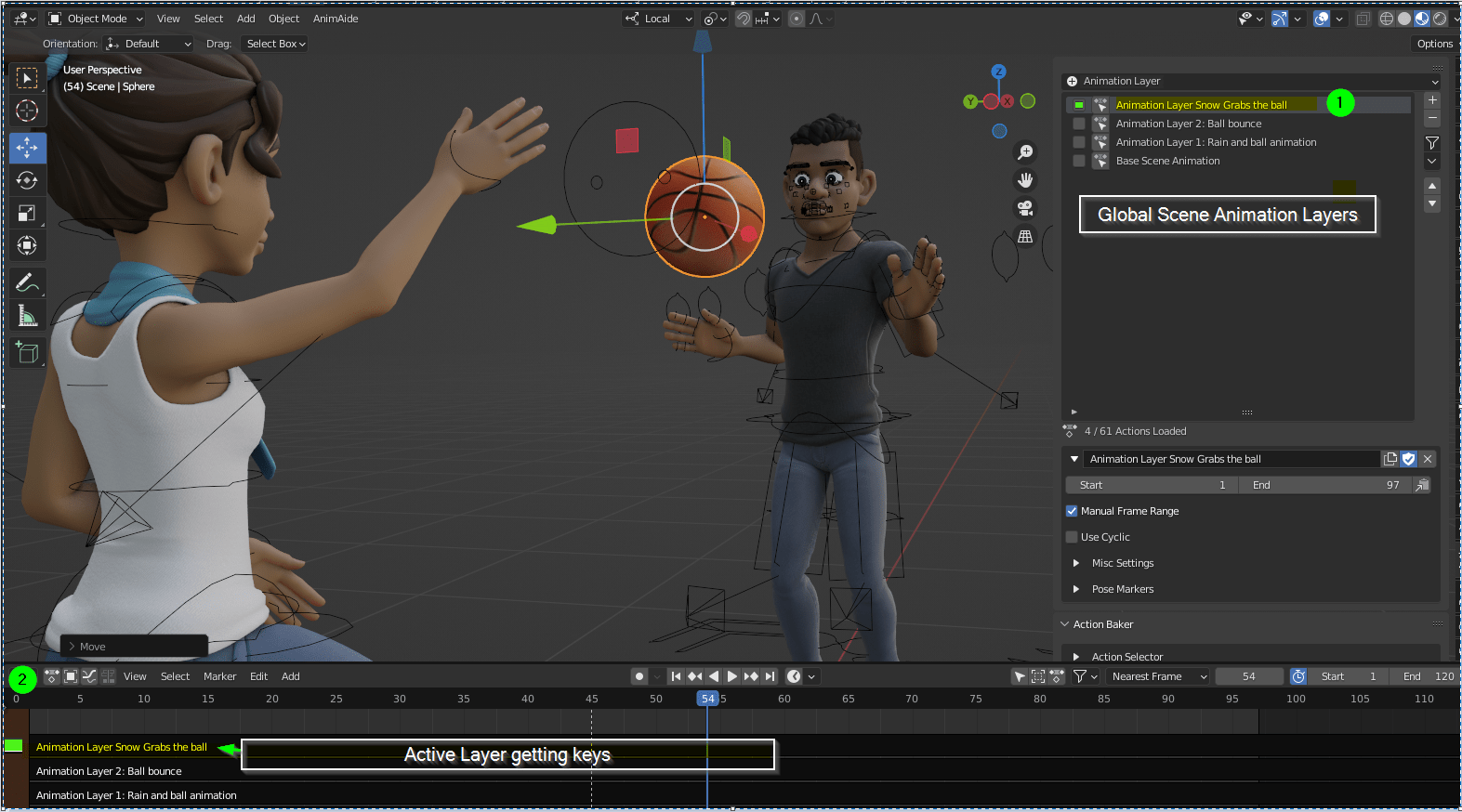
Celebrate exploration. The work always evolves, and Blender should facilitate such change. Changes to the rig should be made possible without breaking already-animated shots. It should be possible to do A/B tests of alternates, from trying out different acting choices to different constraint setups. Animators should be allowed to add ad-hoc extensions to the rig, without needing to going back to the original rig file.
Blender Car Chase Animation
Work directly in the 3D viewport, or even in virtual reality. Mesh-based controls should make posing characters simpler: just point at what you want to move, and drag to move it. It should not be necessary to flip back & forth between the graph editor, dope sheet, and the 3D viewport. Visualisations should be editable; examples are editable motion graphs, or posable onion skins / ghosts.
We also discussed a richer system to describe the roles of bones. This way it’s easier for Blender to do “the right thing” when manipulating / visualising things. An example is an auto-IK system that knows how long IK-chains should be, due to annotations on the bones themselves. This could also avoid the need to have separate IK and FK bone chains.
Better selection tools should allow animators to select related controls more easily. For example when a finger is selected, moving to an adjacent finger (while pressing a hotkey) should continue the selection or even the rest of the hand at that level (i.e, selecting all the finger tips). Another example is the ability to quickly select the same finger on the opposite hand.
Creating Realistic Animated Grass In Blender Archives
Finally, manipulating poses across multiple frames should be possible. Think of things like adjusting a hand grabbing motion to account for a new position of a prop. Basically proportional editing across time.
Be a good Blender citizen. Whatever changes are made, they will fit within the existing look and feel of Blender. UI/UX should feel familiar, and shortcuts / tools should be unified within the new system. To the best of our ability, the new system will be backward compatible. Additionally, the new animation system will need to integrate well into existing “animation adjacent systems” I.e, Grease pencil, motion tracking, etc. We aren’t going to take ownership of these modules, we encourage collaboration with the module owners and community to enhance these tools. We promise to try our best not to break anything :)

Finally, every step of the way will be under the umbrella of the community. With Blender chat, module meetings, Right Click Select, Devtalk, and Phabricator / Gitea there are more ways than ever to get involved. Again, we’re creating tools for
Blender Alpha Release Comes To Omniverse
The Animation 2025 project will start on 1 January 2023, and run until the end of 2025. The timeline below is malleable, and will likely change over the course of the project as new insights develop.
These plans are BIG, and we are excited to have the opportunity to work on them. Three years is likely not enough time to implement all of it, but with a team working on this for three years it’s certain to have a big impact on Blender. And, after that, we feel that the FIFIDS principles will guide the development process for a long time.
The Animation & Rigging module will still be working on fixing bugs and improving the current Blender features. New features will be merged into mainstream

0 Comments
Posting Komentar